


Uncategorized
Colour and Flag Artwork Bleed: A Practical Guide to Print-Ready Files
Oct
Why a Flag File Is Not a Poster File
A flag is printed on fabric, then cut, folded and stitched. It moves in the wind, it is viewed from a distance, and it is often seen from the reverse side. Files prepared like a paper brochure — tight to the trim line, in RGB, with fine detail — tend to come back with white slivers along the hem, dull brand colours, or a logo that has crept too close to the edge.
This guide covers the two areas that cause most artwork revisions on flag orders: colour and bleed. Get these right and your supplier can move straight from file review to production, which matters when you are working toward a fixed shipping date.
Colour for Flag Printing: What Changes on Fabric
Ink behaves differently on woven polyester than on coated paper. There is no bright white coated surface underneath, the weave has texture, and the ink either sits on top of the fibres or is bonded into them. A colour that looks punchy on a monitor can read softer or slightly greyer once printed.
The three common printing methods
- Dye sublimation — the image is transferred under heat and the dye bonds into the polyester fibre. This is the usual route for detailed, full-colour flag designs. Because the dye sits in the fabric rather than on it, the reverse side shows a muted, mirrored image.
- Screen printing — ink is pushed through a mesh screen and sits on the surface. Each colour needs its own screen, so the cost relates to the number of colours. It suits bold spot colours, simple shapes and designs where a strong solid colour matters.
- Digital direct printing — useful for short runs and highly detailed artwork, particularly on fabric blends. Colour can vary with how much ink the fabric absorbs.
RGB, CMYK or spot?
RGB is a screen colour space and is not a reliable reference for fabric. Supply artwork in CMYK when the design is process printed, and use spot colour references when a specific brand colour has to be hit. If your brand has a defined corporate colour, tell your supplier which elements are critical — the logo, a background, a stripe — rather than leaving them to interpret the whole file.
Two practical notes from the production floor:
- Very light tints (below roughly 10%) can look uneven on a textured weave. Consider a slightly stronger tint or a solid block instead.
- Reverse or mirrored text on a single-sided flag will not read correctly from the back. If both sides must be readable, specify a double-sided construction with a blocking layer.
Do not judge colour from an uncalibrated monitor. If colour is commercially important, ask for a physical proof or a strike-off before the full run. A small proof cost is almost always less than a reprint.
What Is Bleed, and Why Flags Need It
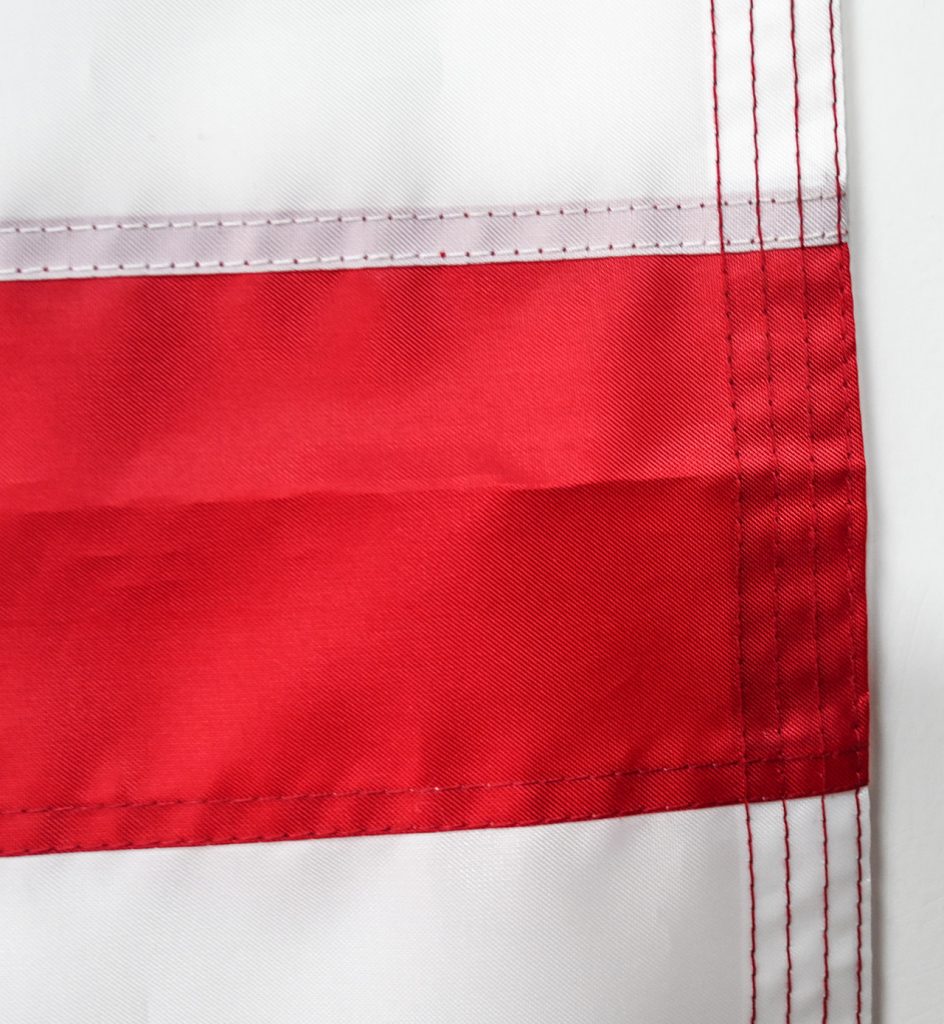
Bleed is artwork that extends beyond the finished size of the product. On a flag, the fabric is cut from a roll and then folded and stitched along the edges — a pole sleeve on one side, a hem around the rest. Fabric shifts slightly during cutting and sewing, so the finished edge rarely lands exactly on the intended line.
If a background colour or pattern stops exactly at the finished size, that small movement shows up as a pale sliver of unprinted fabric along the hem. Flag artwork bleed prevents this: the colour continues past the cutting line, so any variation is trimmed away or hidden inside the fold.
Bleed is not only about the hem. Grommets and pole sleeves also consume part of the surface. A design that runs edge to edge needs enough bleed to survive both the trim and the fold.
How Much Bleed and Safe Area to Allow
Exact figures vary with flag size, fabric, edge finish and printing method, so always confirm against the specification for your order. The table below shows the general approach used across the industry.
| Element | Purpose | General guidance |
|---|---|---|
| Finished size | The size the customer receives | Build the file at 1:1, or clearly state the scale |
| Bleed | Extends artwork past the cut line so no unprinted edge appears | Typically 10–20 mm per side, confirmed per order |
| Safe area | Keeps text, logos and key imagery away from folds and stitching | Keep important elements well inside the finished edge, allowing for the hem and pole sleeve |
| Pole sleeve / heading | Fabric folded over to take the pole or rope | Treat as unusable for artwork; note the sleeve side on your spec sheet |
Where a design relies on a border or a frame, widen the safe area rather than narrowing it. It is easier to make a border slightly thicker than to reposition every element after a hem eats into it.
Building Print-Ready Flag Artwork: A Checklist
Most files that arrive with problems fail on a small number of points. Running through this list before you send artwork saves a round of emails.
- Work at finished size plus bleed. State the finished size, the bleed and the sleeve side in the file name and on the spec sheet.
- Keep vectors for logos, text and line art. Raster images should be supplied at a resolution appropriate to the final print size — for large flags, a lower dpi at full size is normal because the viewing distance is greater.
- Convert fonts to outlines or embed them. A missing font is one of the most common causes of delay.
- Name spot colours properly. “Blue” means nothing to a printer; a recognised spot reference does.
- Do not add crop marks. Flags are not trimmed to crop marks. Supply the bleed and describe the finished size instead.
- Flatten transparencies if you are sending a raster format, and check that the flattening has not altered any overlaps.
- Send a flattened preview alongside the working file so your supplier can confirm the intended appearance at a glance.
Supplying clean, print-ready flag artwork is not about artistic perfection — it is about removing ambiguity. The clearer the file, the fewer questions the production team has to ask.
Keeping Colour Consistent Across Repeat Orders
Repeat orders are where colour drift becomes visible, particularly when flags are displayed side by side at an event. A few habits reduce the risk:
- Archive the approved file exactly as it was sent, not a later revision.
- Record the fabric type and weight used for the original order.
- Keep the approved physical proof or strike-off as the colour reference.
- When reordering, reference the original order number so the same specification is used.
With dye sublimation in particular, the base fabric shade affects the result. If the base fabric changes between orders, the same file will not print identically.
A Note on Working with Your Supplier
Flagmill is a flag manufacturer based in Weifang, Shandong, supplying importers, distributors and online sellers across Europe, North America and Australia. Our team reviews artwork before production begins and will flag issues such as insufficient bleed, text inside the hem area, or colour references that will not reproduce well on fabric. Raising those points at the file stage is far cheaper than discovering them after the goods have shipped.
If you are unsure how a design will translate, send the file with your target finished size and sleeve preference, and ask for a pre-production review or a sample. It also helps to tell us the end use — a flag flown outdoors on a pole and one displayed flat in a retail setting are viewed very differently, which can affect how much contrast and colour saturation the design needs.
Common Mistakes That Cause Reprints
- Artwork built to finished size with no bleed, producing pale edges along the hem.
- Text or a logo placed inside the pole sleeve or hem area.
- Files supplied in RGB with no colour reference for critical brand colours.
- Missing fonts, unlinked images or unflattened transparencies.
- Single-sided artwork designed as if both sides will read normally.
- Hairline strokes and very fine text that disappear into the weave.
Next Step
Good colour and correct flag artwork bleed are the difference between a design that looks sharp on a pole and one that comes back with an apology. Build your file with bleed, keep critical elements inside the safe area, use reliable colour references, and confirm the specification for your order before production.
Ready to put this into practice? Browse the flag and printed textile range at Flagmill, or send your artwork with your target size and finish so our team can check it before it goes to print.
Browse the full range: https://www.flagmill.com/shop/
Email: flagswin@flag-win.vip
WhatsApp: +86 13031678795
Facebook: https://www.facebook.com/StarFlagFactory/
Alibaba.com: https://wfqyflag.en.alibaba.com/
